The Economic and Financial Crimes Commission (EFCC) has secured a final forfeiture order for $163,592 linked to an alleged international fraud involving a United States-based law firm and a Nigerian businessman, Akpasi Oziegbe.
The forfeiture order was granted on Friday by Justice M. S. Liman of the Federal High Court, Abuja, following an application by the anti-graft agency.
According to the EFCC, the court ruled that Oziegbe failed to establish legitimate ownership of the funds, which were traced to his domiciliary account operated under the business name Micoz Bluelink Enterprise with United Bank for Africa (UBA).
The commission alleged that the money was obtained through an elaborate impersonation scheme in which Oziegbe allegedly posed as Edward Campbell, a former employee of US-based company Applied Industrial Technologies, who had sustained a workplace accident.
In a statement issued by EFCC spokesperson Dele Oyewale, the commission disclosed that Oziegbe allegedly contacted the US law firm, Steven J. Mandel & Co., on June 27, 2022, impersonating Campbell and claiming that the company had failed to pay an agreed compensation settlement.
Information obtained from the United States Federal Bureau of Investigation (FBI) reportedly showed that Applied Industrial Technologies had issued a $165,157 cheque to Campbell as compensation for the workplace accident.
However, the alleged impersonator instructed the law firm to deduct its legal fees and transfer the remaining amount into a bank account he provided.
The firm subsequently transferred $163,592 into the account on July 20, 2022. A day later, JPMorgan Chase Bank notified the lawyers that the cheque had been altered and was fictitious.
Following the discovery, the law firm contacted Applied Industrial Technologies, confirmed the alleged fraud and reported the incident to the US Secret Service and the FBI.
The EFCC further disclosed that UBA had flagged the transaction as suspicious and sought verification through its correspondent bank, Citibank. After the transaction was confirmed to be fraudulent, UBA placed a lien on the funds following a refund request from JPMorgan Chase Bank.
Interestingly, Oziegbe later petitioned the EFCC, accusing some UBA officials of conspiracy, forgery and obtaining money under false pretences.
The commission said its Extractive Industry Fraud Section commenced investigations in May 2024 after receiving a petition from GAIA & Montgomery Legal on his behalf.
However, investigations, supported by documents and intelligence obtained from the FBI, allegedly established that the disputed funds originated from the fraudulent transaction rather than any legitimate business arrangement.
Oziegbe reportedly claimed that the money represented payment for materials supplied to a US-based company but allegedly failed to provide supporting documents to substantiate the claim.
To prevent the withdrawal of the funds, the EFCC obtained an account-freezing order on September 9, 2024, in Suit No. FHC/ABJ/CS/1297/2024.
On August 15, 2025, the court granted an interim forfeiture order and directed anyone with an interest in the funds to appear and explain why they should not be permanently forfeited.
Following the proceedings, EFCC prosecution counsel, Ekele Iheanacho, a Senior Advocate of Nigeria (SAN), led the legal team that secured the final forfeiture order.
The commission said the recovered $163,592 would be forfeited to Steven J. Mandel & Co. through the Federal Government of Nigeria.
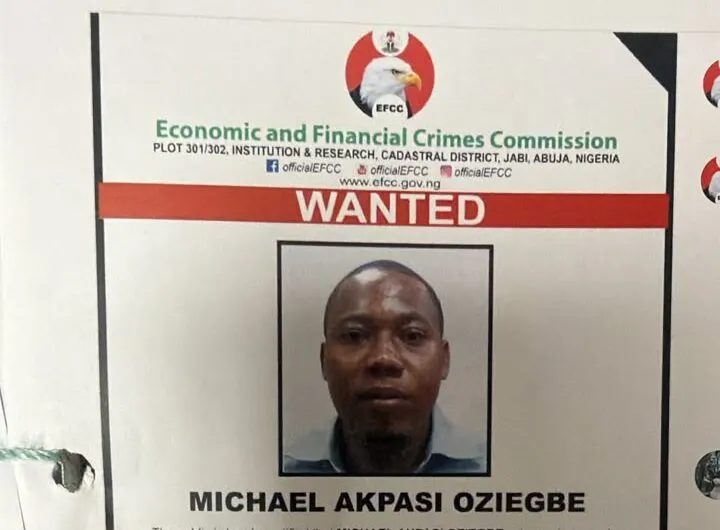
The EFCC had previously declared Oziegbe wanted in connection with the alleged fraud.