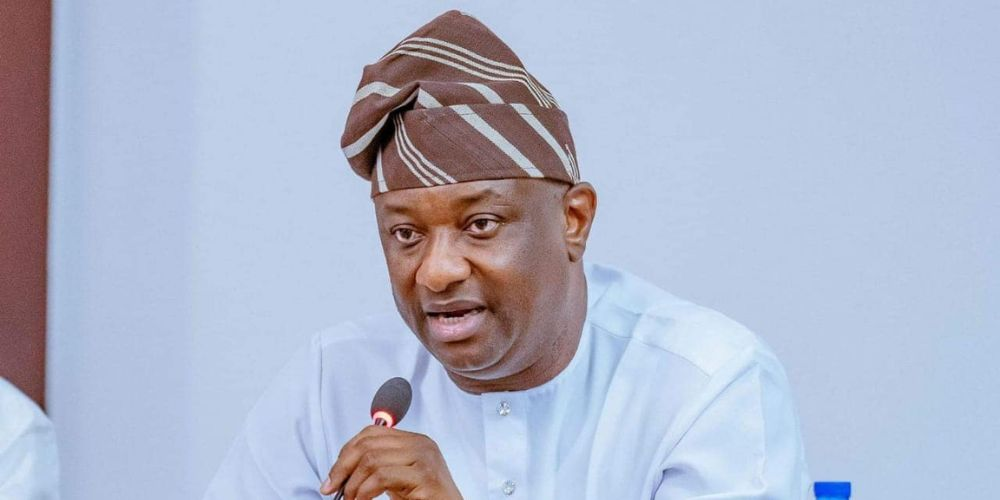
he Minister of Aviation and Aerospace Development, Festus Keyamo, SAN, has said the N70,000 national minimum wage can no longer adequately cushion Nigerian workers against the rising cost of living.
Keyamo made the remarks at the 2026 National Pre-Retirement Summit, organised by XEM Consultants Limited, amid renewed calls by organised labour for higher wages.
The minister said persistent economic pressures had significantly reduced workers’ purchasing power and urged the Federal Government to reach a compromise with labour over its demand for a substantial wage increase.
Organised labour has been pushing for a new minimum wage of up to N500,000.
Why N70,000 Is Becoming a Major Issue
Keyamo, a former Minister of State for Labour and Employment, recalled the negotiations that led to the increase in the national minimum wage from N30,000 to N70,000 in 2024.
But according to him, the economic situation has changed considerably since then.
He said the current wage has struggled to keep pace with the rising cost of essential goods and services, leaving workers with reduced purchasing power.
The minister also raised concerns about the treatment of workers in some government institutions.
He particularly criticised situations where employees allegedly struggle to access basic allowances while senior officials receive substantial funding for overseas trips.
“I will have none of it. Without these workers, we will not have a country,” Keyamo said.
He stressed that workers remain critical to the functioning of government and the wider economy.
“It’s not the machines or everything that you have, it’s the human factor. Without that, no machine will move,” he said.
Keyamo consequently urged ministers and heads of government agencies to put workers’ welfare at the centre of their decisions and remove bureaucratic obstacles that could affect productivity.
Ajaero: Workers Need Relief Now
The President of the Nigeria Labour Congress, Joe Ajaero, also called for urgent measures to reduce the economic pressure on workers and other Nigerians.
Ajaero urged the Federal Government to use increased oil revenues to cushion citizens against rising transportation and food costs.
He argued that higher international crude oil prices were generating additional revenue for oil-producing countries, including Nigeria, and that part of the gains should be used for immediate interventions.
“Now, can’t you use this money to embark on some interventionary measures like other countries where this is affected, so that we’ll now be alive till the time when they will say minimum wage?”
For Ajaero, the debate should not be limited to the figure printed on a worker’s payslip.
‘Negotiations Are Not Just Figures’
The NLC president said what matters is how much workers can actually buy with their salaries.
“Negotiations are not just figures,” Ajaero said.
He explained that even a salary of N1 million could become inadequate if the prices of basic commodities rise sharply.
Using rice as an example, he said a worker earning N1 million would still face serious difficulties if a bag of rice cost N500,000.
His argument is that wage negotiations must take inflation and the cost of living into account, rather than focusing only on nominal salary figures.
NLC Wants Automatic Wage Adjustments
Ajaero called for wages and pensions to be linked to inflation or a cost-of-living index.
Under such a system, he argued, workers’ earnings would automatically adjust when inflation rises significantly.
“Unless you index it either based on cost of living index or inflation, immediately inflation goes like this, automatically it will adjust to this,” he said.
He also wants pensioners included in discussions around minimum-income protections, arguing that they are equally exposed to rising living costs.
According to Ajaero, the decision to shorten the minimum-wage review period from five years to three years was intended to make wage adjustments more responsive to economic changes.
Next Wage Review: Labour Wants Talks Early
Ajaero said preparations for the next minimum-wage review, expected around March or April, should begin early.
“This minimum wage is supposed to expire March–April, so the conversation ought to start early. That’s a three-year cycle,” he said.
However, he stressed that workers could not simply wait for the next wage review before receiving relief.
“But now we are more concerned on ‘give us this day’ — how to survive today before that time.”
Ajaero Questions CNG Impact
The NLC president also questioned the impact of government efforts to reduce transportation and energy costs, particularly the Compressed Natural Gas (CNG) programme.
He asked whether there were enough CNG facilities and converted vehicles across the country for ordinary workers to benefit meaningfully from the initiative.
The comments add to the growing debate over wages, inflation, transportation costs and workers’ purchasing power, as the next minimum-wage review approaches.